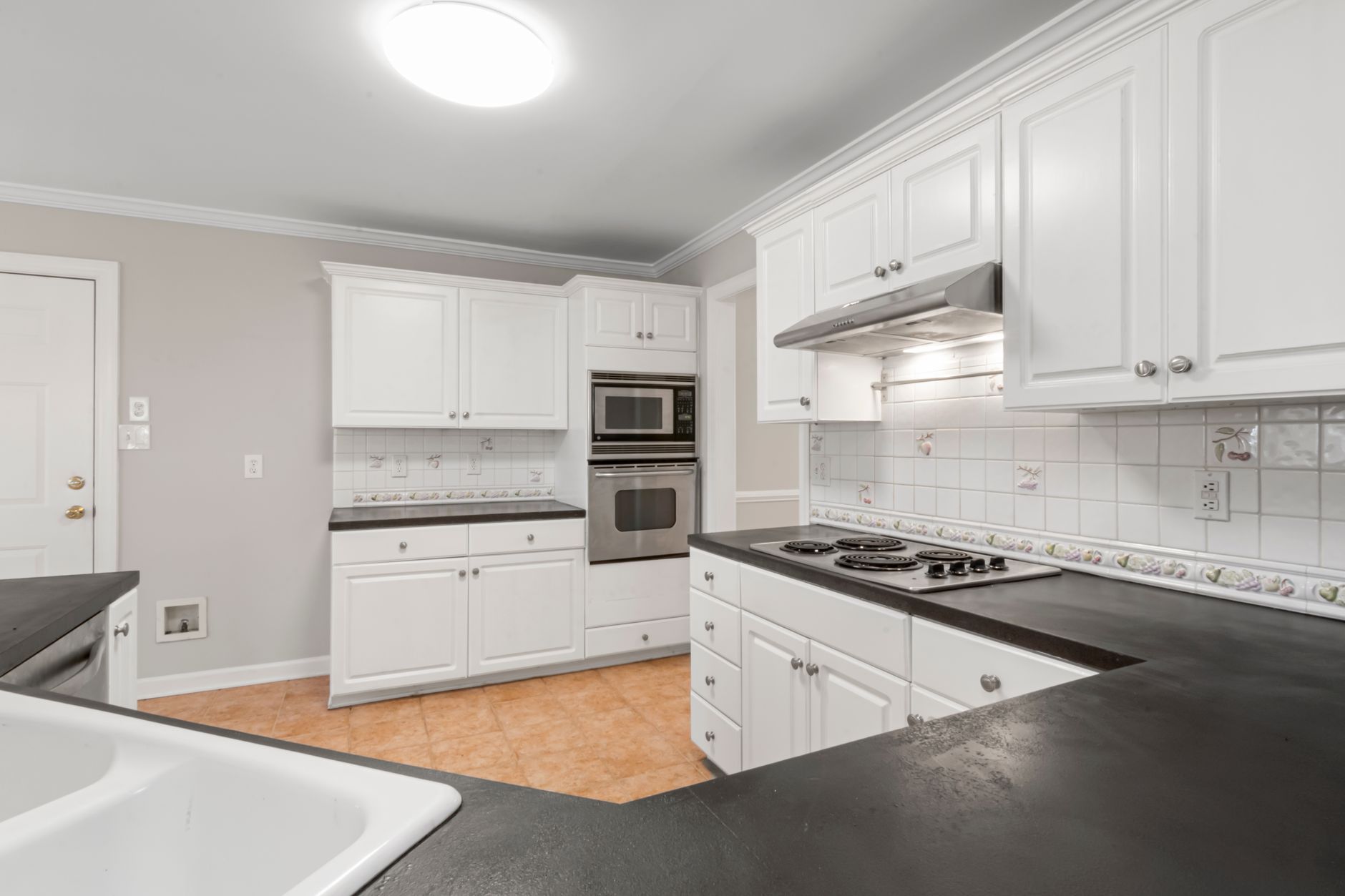
Open enough kitchen cabinets in the Lakewood tract blocks that went up in the early 1950s and a pattern shows up. A great many of these houses are still working off a laminate counter, either original or a 1980s replacement, still doing the job. The trade talks about laminate as a stopgap, something to put up with until the real thing arrives. That is a sales position, not a technical one.
Laminate is a manufactured product with known properties and known failure points. In some kitchens it is the wrong material, and putting it back is money spent on a surface that will embarrass the house. In others it is the correct answer, and specifying stone there costs four or five times as much to solve a problem the room does not have.
Any shop that quotes stone will quote it well, and countertops lakewood edge, ca is one of many around the south basin doing slab work for kitchens where slab work is the right call. This is about the other case: what high pressure laminate actually is, how the two ways of building a laminate top differ, where those tops die, and how to tell which side of the line your kitchen sits on.
What high pressure laminate actually is
High pressure laminate is a sandwich, and the layers explain almost every one of its habits.
The bulk of it is kraft paper, several sheets, saturated with phenolic resin. On top of that sits a printed decorative sheet impregnated with melamine resin, and over that a translucent overlay that does the wearing. The stack goes into a press under heat and pressure until the resins cure into one rigid sheet, a little over a millimetre thick.
Two things follow. The sheet on its own is brittle and has no structural value, so it has to be bonded to a substrate before it becomes a countertop. And the part you see and touch is only the top fraction of that millimetre. The decorative layer is paper, and there is nothing underneath it to sand back to.
The old melamine tops are a different product
Low pressure melamine, sometimes sold as thermally fused laminate, is not the same thing under another name. There the decorative paper is fused directly onto the particleboard panel, with no separate sheet and no phenolic core. It is fine on a cabinet interior or a shelf.
It does not survive as a working counter. The face is thinner, the edges chip because no laminated edge band protects them, and there is nothing to bond to a shaped substrate, so a rolled front edge is impossible. A postwar kitchen that got a melamine top in a hurry is usually the one people point to when they say laminate does not last.
Post formed tops versus a custom built top
These are the two real options, and they are different trades.
Post formed
A post formed top is made by heating the laminate sheet and rolling it over a shaped substrate so it wraps the front edge and continues up into a coved backsplash in one continuous face. No joint at the front edge, no joint where the deck meets the splash. Water thrown at the back of the counter has nowhere to get in.
It is a factory product sold in stock lengths and depths, in whatever patterns the supplier stocks. At an inside corner two lengths are mitred and pulled together with draw bolts in routed slots, sealed at the joint. That mitre is the one seam, and it is the only part of a post formed job that fails slowly: if the bolts were not drawn tight, the corner opens a hair over the years and the substrate starts drinking.
The trade offs are those of any stock item. The depth is fixed, the splash height is fixed, the pattern list is short, and the coved splash is instantly recognisable to a trained eye.
Custom built
A custom top is a substrate built to your layout in a shop, with sheet laminate laid flat on the deck and the edge finished separately. The front edge can be a self edge, the same laminate applied and trimmed flush, or a hardwood band, or a metal edge, or a build up that makes the apparent thickness whatever you want.
The splash is a separate piece here, a strip of substrate faced in the same laminate and set against the wall, so there is a caulked joint at the deck rather than a cove. That joint is the price of the flexibility.
What you gain is real. The deck depth is whatever the cabinets are. Seams go where the fabricator decides, not where a stock length runs out, so they can land at an inside corner or a sink cutout. And a square edge with a dark contrasting band reads as a deliberate decision rather than an apology.
The substrate is the part that fails
Nobody chooses a counter by its substrate, and the substrate decides whether the top lasts eight years or thirty.
Industrial particleboard is the standard, for good reasons: dimensionally stable, flatter than plywood, routs cleanly, cheap. Its weakness is water. Once it takes on moisture it swells, and the swelling is permanent, because the material has expanded rather than deformed.
MDF behaves similarly with a denser, smoother cut edge, which helps where an edge is shaped or a thin laminate might telegraph the surface below. Plywood tolerates moisture better and is the sensible substrate for a laundry, a garage or anywhere damp. It is less flat, and voids or grain can read faintly through the sheet, so it is a compromise rather than a free upgrade.
Laminate tops die at the sink cutout
Almost always. Not from wear, not from heat, not from knives.
Cut an opening for a sink and you expose raw substrate around the whole perimeter, running downhill toward a fixture that gets splashed every day. If that edge is not sealed, water wicks in, the substrate swells, the swelling lifts the laminate off the deck, and the front of the cutout develops the soft bulge every one of these kitchens eventually shows.
The fix is entirely in the preparation. The cut edge gets sealed, with silicone or a coat of varnish or both, before anything is installed. A drop in sink sits on a proper bead of sealant under its flange, and that bead is a maintenance item worth cutting out and redoing every few years instead of waiting for a symptom. Any drip under the sink base gets dealt with immediately, because the deck above it has no tolerance for standing water.
Undermount sinks in laminate
It can be done, with a system that carries the sink on a subframe and finishes the cutout edge in solid surface or stainless so no substrate is ever wet. Those systems work when installed exactly as intended.
Most shops still decline, and the reason is fair. The failure is slow, invisible until severe, and repairable only by remaking the top. If an undermount bowl is not negotiable in your kitchen, that preference is itself an argument for a different material.
The stone look patterns, and what gives them away
Print quality has moved a long way. Patterns are photographed from real slabs at high resolution, with embossed texture and matched gloss levels, and from standing height in normal kitchen light a good one is convincing.
Three things give it away. The edge, first and worst: a square edge shows a self edge band with a visible dark line where it meets the deck, and a post formed edge has a radius no stone fabricator would produce. Second, the pattern repeats, because a slab is unique and a printed sheet is a cycle, so a marble pattern repeats within a long run. Third, nothing carries across a seam, since the sheets were cut from a roll, not laid from one block.
A smaller scale, lower contrast pattern keeps all three tells quiet. A dramatic book matched marble look puts the edge in an argument it cannot win.
Heat, chips and what can actually be repaired
The trivet rule is not fussiness. A hot pan sets a scorch into the decorative layer, and because that layer is paper microns thick the mark is permanent. There is no sanding, polishing or refinishing step available. A burn is a scar for the life of the top.
Chips happen at corners and cutout edges, where the brittle sheet is unsupported. Colour matched repair paste is worth doing, since an unfilled chip is an open door to the substrate. Expect it to disappear at conversational distance and to show under raking light from a window.
Everyday durability is better than the reputation. Laminate is not porous, so it does not stain the way unsealed stone can, and it does not etch under lemon juice or vinegar. It scratches, it burns, and it cannot be resurfaced. That is the whole profile.
Scribing to a wavy plaster wall
This is where laminate quietly wins in old housing stock. Plaster walls in these houses are rarely straight and almost never square, and a splash has to follow whatever is there.
A laminate top gets scribed. The installer marks the wall's actual line onto the back of the splash and takes the waste off with a belt sander or a plane, on site, in minutes, until the piece sits tight. A stone splash in the same corner means diamond tooling or a caulk joint wide enough to notice, and the result is often less clean than the scribed one.
The swap timeline
A laminate replacement is short. A custom top is templated, built in a shop and set within days rather than weeks, with no undermount sink to wait on. A post formed top in a stocked pattern can sometimes be cut, mitred and set in one visit, so the kitchen is out of service for an afternoon.
For a rental turnover, a sale coming up fast, or a household that cannot lose the kitchen for a week, that schedule is a feature rather than a consolation prize.
When laminate is the wrong answer
A house going on the market in a Lakewood block where every comparable sale shows stone. Buyers read the counter as a proxy for how the rest of the house was kept, fairly or not.
A serious cook, who will put a hot pan down and run water without thinking about the sink bead.
A wet bar or any small bowl in a tight top, where a lot of water meets a lot of cut edge in a small area.
An island with a seating overhang, because laminate has no useful unsupported span and the overhang needs a supported deck.
When stone is the wrong answer
A rental unit, where the surface has to look clean and survive tenants rather than impress anybody, and a chip is a maintenance call rather than a remake.
A laundry room, a garage or a workshop bench. Plywood substrate, a hard wearing pattern, done.
A budget that would only reach the thinnest prefab stone. A well built laminate top with a considered edge, set tight to the wall, presents better than a thin prefab piece with a laminated build up edge and a seam where the stock length ran out.
The question is not which material is better. It is which set of failure modes you can live with in this kitchen, and whether the difference in money does more good here or somewhere else in the house.